The world has never been so alive with possibility; opportunities we once thought inconceivable are now right in front of us.
Over the years, Oxford Scholastica has welcomed thousands of young people from across the globe – and while the students who join us are excited for the future ahead, they also face high levels of uncertainty in a world of climate change, misinformation and political upheaval.
To better understand how teenagers view their future, we surveyed over 1,000 students across 40 countries. We measured optimism across multiple dimensions – personal, economic, environmental and political – and identified students’ core concerns for the future.
The findings reveal not only where students feel confident but also where support is needed, offering valuable insights for educators, policymakers and researchers to empower the next generation.
Key Takeaways
- Global optimism: Overall optimism among teenagers averages 3.80 out of 5, with notable regional differences – highest in Sri Lanka (4.33) and lowest in Kuwait (2.92).
- Personal and economic confidence: Teenagers feel most optimistic about their own lives. In 39 of 40 countries, personal optimism ranks highest (avg. 4.42), followed closely by economic optimism (avg. 4.15), showing strong self-confidence and personal agency.
- Environmental and political confidence: Optimism is lowest for political (avg. 3.25) and environmental (avg. 3.37) issues, reflecting widespread distrust in governance and global stability.
- Top global concerns: Across 32 of 40 countries, climate change ranks among teenagers’ top three worries, followed by political instability and access to quality education. Issues like job automation and income inequality are cited much less, highlighting personal vs systemic worry patterns.
We Help Students Seize the Future
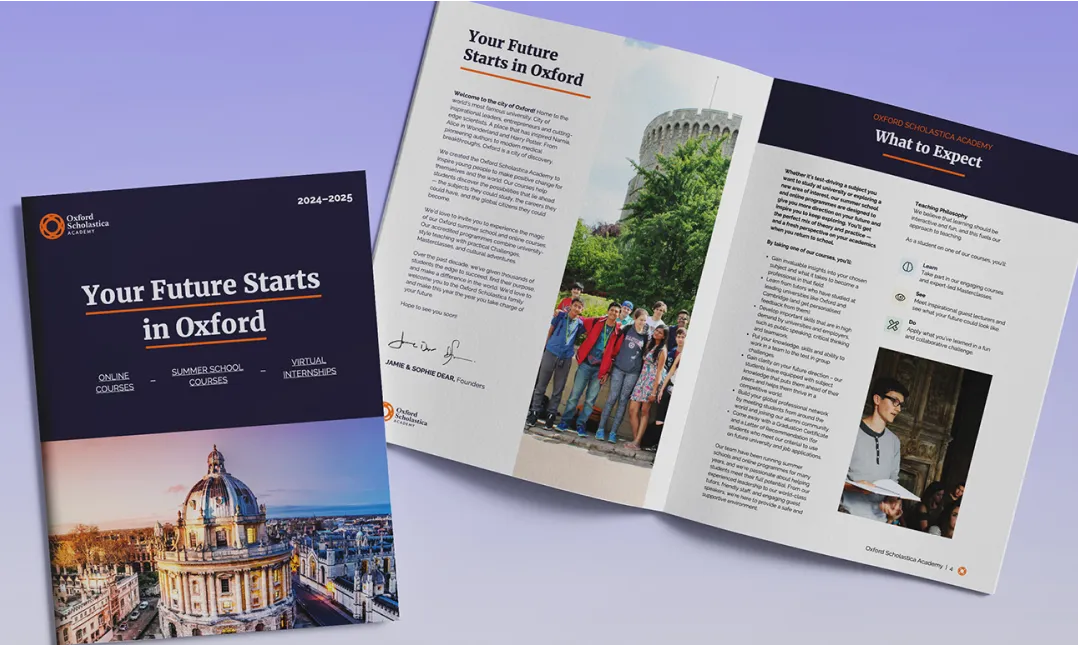
Our immersive programmes give young people with big dreams the opportunity to unlock their potential.
Methodology: How Student Data Was Collected
This report is based on data collected from the 2024 and 2025 Oxford Scholastica Essay Competition. We surveyed 1,323 entrants, aged 14-18, across 40 countries to gather the latest student insights.
Results for countries with limited responses are indicative rather than definitive.
Who Took Part
Students were surveyed from four global regions:
- Europe: Albania, Armenia, Cyprus, France, Germany, Italy, Poland, Russia, Turkey, Ukraine, United Kingdom
- Africa: Egypt, Ghana, Kenya, Nigeria, Rwanda, South Africa
- Asia: Bangladesh, China, Hong Kong, India, Indonesia, Japan, Kazakhstan, Kuwait, Kyrgyzstan, Malaysia, Nepal, Pakistan, Philippines, Singapore, South Korea, Sri Lanka, Thailand, United Arab Emirates, Uzbekistan, Vietnam
- Americas: Brazil, Canada, United States
What Students Rated
Students self-assessed their levels of optimism on a scale of 1-5 (1 = very pessimistic; 5 = very optimistic) across four dimensions:
- Optimism for personal future
- Optimism for economic future
- Optimism for environmental future
- Optimism for political outlook
Students also ranked their top three concerns for the future from the following list:
- Climate change
- Job automation
- Political instability
- Mental health
- Income inequality
- Cybersecurity and data privacy
- Access to quality education
- Affordable housing
- Healthcare availability and affordability
- Discrimination and social injustice
Global Trends in Overall Student Optimism Across 40 Countries
The following table summarises the average student rating across the 40 countries surveyed for all four dimensions: personal, economic, environmental and political.
|
Country |
Personal |
Economic |
Environmental |
Political |
Overall |
|
Albania |
4.20 | 3.80 | 3.60 | 3.20 | 3.76 |
| Armenia | 4.86 | 4.29 | 3.71 | 3.29 | 4.06 |
| Bangladesh | 4.41 | 4.24 | 3.76 | 3.28 | 3.92 |
|
Brazil |
4.86 | 4.29 | 3.14 | 3.00 | 3.77 |
|
Canada |
4.67 |
4.50 | 3.67 | 3.42 |
4.09 |
| China | 4.20 | 4.00 | 2.40 | 2.80 |
3.36 |
| Cyprus | 4.86 | 4.43 | 3.29 | 3.43 | 4.09 |
|
Egypt |
4.44 | 4.15 | 3.33 | 3.03 |
3.70 |
| France | 4.00 | 4.13 | 2.25 | 2.38 | 3.23 |
| Germany | 4.43 | 4.07 | 3.14 | 3.21 | 3.73 |
| Ghana | 3.86 | 3.71 | 3.57 | 3.43 | 3.63 |
| Hong Kong | 4.67 | 4.33 | 3.58 | 3.25 | 3.90 |
|
India |
4.45 | 4.36 | 3.49 | 3.49 | 3.93 |
| Indonesia | 4.38 | 4.41 | 3.71 | 3.68 | 4.07 |
| Italy | 4.20 | 4.00 | 3.00 | 2.40 |
3.36 |
| Japan | 4.70 | 4.00 | 3.20 | 2.70 | 3.78 |
| Kazakhstan | 4.71 | 4.56 | 3.64 | 3.76 | 4.17 |
|
Kenya |
4.59 | 4.49 | 4.08 | 3.96 | 4.31 |
| Kuwait | 4.00 | 4.00 | 2.40 | 1.80 | 2.92 |
| Kyrgyzstan | 4.58 | 4.42 | 3.25 | 3.50 |
4.00 |
|
Malaysia |
4.48 | 4.35 | 3.65 | 3.65 |
4.05 |
|
Nepal |
5.00 | 4.80 | 3.60 | 3.80 | 4.24 |
| Nigeria | 4.43 | 4.18 | 3.92 | 3.69 |
4.08 |
| Pakistan | 4.55 | 4.09 | 3.73 | 3.27 | 3.94 |
| Philippines | 4.09 | 3.82 | 3.27 | 3.23 | 3.66 |
| Poland | 4.20 | 3.60 | 3.00 | 2.30 | 3.24 |
|
Russia |
4.47 | 4.21 | 3.82 | 3.71 | 4.07 |
|
Rwanda |
3.50 | 3.33 | 2.83 | 3.50 | 3.20 |
| Singapore | 4.07 | 4.04 | 3.18 | 3.32 | 3.69 |
| South Africa | 4.50 | 4.00 | 3.83 | 3.00 | 3.87 |
| South Korea | 4.44 | 4.22 | 3.41 | 3.67 |
3.93 |
| Sri Lanka | 4.75 | 4.38 | 4.63 | 3.63 |
4.33 |
| Thailand | 4.64 | 4.14 | 3.43 | 3.43 | 3.87 |
| Turkey | 4.09 | 3.75 | 2.62 | 2.58 | 3.22 |
|
Ukraine |
4.51 | 4.02 | 3.20 | 3.24 | 3.79 |
| United Arab Emirates | 4.64 | 4.45 | 3.14 | 3.18 | 3.85 |
| United Kingdom | 4.31 | 4.02 | 3.06 | 3.04 |
3.61 |
|
United States |
4.74 | 4.32 | 3.58 | 3.47 | 3.99 |
|
Uzbekistan |
4.42 | 4.19 | 3.53 | 3.71 |
3.91 |
| Vietnam | 4.06 | 4.00 | 3.33 | 3.39 |
3.76 |
Overall Optimism: Average Student Outlook

- #1 Sri Lanka 86.6%
- #40 Kuwait 58.4%
| #1 | Sri Lanka | 4.33 | #36 | Poland | 3.24 |
| #2 | Kenya | 4.31 | #37 | France | 3.23 |
| #3 | Nepal | 4.24 | #38 | Turkey | 3.22 |
| #4 | Kazakhstan | 4.17 | #39 | Rwanda | 3.20 |
| = #5 | Cyprus / Canada | 4.09 | #40 | Kuwait | 2.92 |
- Highs: The most overall optimistic students are found in South Asia and Africa, with Sri Lanka appearing at the top of all countries.
- Lows: The lowest levels of overall optimism appear in Europe and the Middle East, with students in Kuwait expressing the lowest overall optimism.
- Global trend: Differing regional factors such as political instability, economic pressures and climate anxiety likely contribute to more pessimistic outlooks.
What this tells us: Students’ overall optimism levels are measurably affected by the stability and prospects of the regional social, economic and political systems around them.
Broaden Your Child’s Perspective
At our Oxford summer school, students from across the world come together to create a community unrestricted by regional limits.

How Students Feel About Their Future Across Four Dimensions
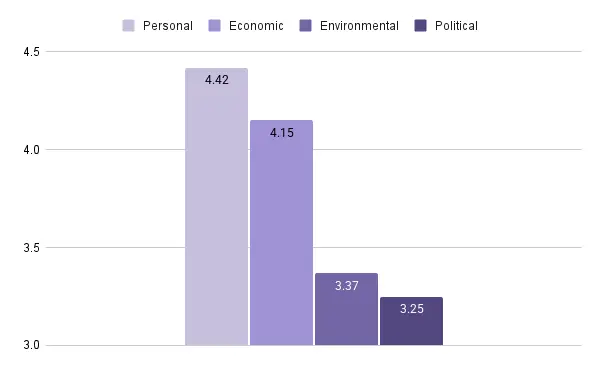
Examining the data across all four dimensions, it is clear that students feel most optimistic about their personal lives and economic futures, while their outlooks on the environment and politics are significantly less positive.
On average, students give a score of 4.42 for personal optimism and 4.15 for economic optimism, whereas environmental and political optimism lag behind at 3.37 and 3.25 respectively.
Personal Optimism: Students’ Confidence in Their Own Lives
Personal optimism captures how students feel about their own future, including their education, personal career, goals and relationships.
| #1 | Nepal | 5.00 | #36 | Vietnam | 4.06 |
| = #2 | Armenia | 4.86 | = #37 | Kuwait | 4.00 |
| = #2 | Brazil | 4.86 | = #37 | France | 4.00 |
| = #2 | Cyprus | 4.86 | #39 | Ghana | 3.86 |
| #5 | Sri Lanka | 4.75 | #40 | Rwanda | 3.50 |
- Highs: Nepal scores a perfect 5.00 in personal optimism – the only country to do so – and is followed closely by Armenia, Brazil and Cyprus.
- Lows: Rwanda scores lowest yet remains moderately optimistic at 3.50.
- Global trend: Students in 39 of 40 countries rate personal optimism the highest of all four dimensions, including countries with lower overall optimism like Kuwait and Rwanda.
What this tells us: Students maintain a strong sense of self-belief and personal agency, showing resilience even when external factors are uncertain.
Economic Optimism: Belief in Future Financial Success
Economic optimism reflects how confident students are about future job opportunities, financial stability and economic conditions.
| #1 | Nepal | 4.80 | #36 | Albania | 3.80 |
| #2 | Kazakhstan | 4.56 | #37 | Turkey | 3.75 |
| #3 | Canada | 4.50 | #38 | Ghana | 3.71 |
| #4 | Kenya | 4.49 | #39 | Poland | 3.60 |
| #5 | United Arab Emirates | 4.45 | #40 | Rwanda | 3.33 |
- Highs: Nepal leads again with a score of 4.80, followed by Kazakhstan, Canada, Kenya and the UAE.
- Lows: Rwanda and Ghana again rank within the five lowest-scoring countries – alongside Poland, Turkey and Albania.
- Global trend: Economic optimism is generally high regardless of national wealth.
What this tells us: Students across all countries perceive economic success as relatively attainable, indicating a strong sense of personal capability and agency.
Environmental Optimism: Hopes for the Planet
Environmental optimism measures how hopeful students feel about the future of the environment, climate change and the planet’s natural resources.
| #1 | Sri Lanka | 4.63 | #36 | Rwanda | 2.83 |
| #2 | Kenya | 4.08 | #37 | Turkey | 2.62 |
| #3 | Nigeria | 3.92 | = #38 | China | 2.40 |
| #4 | South Africa | 3.83 | = #38 | Kuwait | 2.40 |
| #5 | Russia | 3.82 | #40 | France | 2.25 |
- Highs: African countries lead, with Kenya, Nigeria and South Africa scoring well above the global average of 3.37.
- Lows: France is a clear negative outlier, reflecting a wider trend of climate change anxiety among youth, particularly in high-income countries.
- Global trend: African countries tend to be more environmentally optimistic, while several European and East Asian nations are less so.
What this tells us: While students in some countries feel confident about environmental progress, concerns about climate change remain prominent. This may be particularly evident in countries where teenagers perceive insufficient action or political engagement on environmental issues.
Political Optimism: Trust in Government and Global Policies
Political optimism reflects students’ positivity regarding government actions, policies, global relations and political stability.
| #1 | Kenya | 3.96 | #36 | Turkey | 2.58 |
| #2 | Nepal | 3.80 | #37 | Italy | 2.40 |
| #3 | Kazakhstan | 3.76 | #38 | France | 2.38 |
| = #4 | Uzbekistan | 3.71 | #39 | Poland | 2.30 |
| = #4 | Russia | 3.71 | #40 | Kuwait | 1.80 |
- Highs: Even in countries with high overall optimism, like Kenya and Nepal, political optimism scores remain lower than personal or economic optimism.
- Lows: Kuwait and several European nations show deep pessimism politically, often aligning with low environmental optimism in the same countries.
- Global trend: Students across the globe rate political optimism the lowest of the four dimensions.
What this tells us: While students tend to feel confident in their personal and economic futures, they often doubt the stability and effectiveness of the political systems around them.
How the UK Ranks in Student Optimism Worldwide
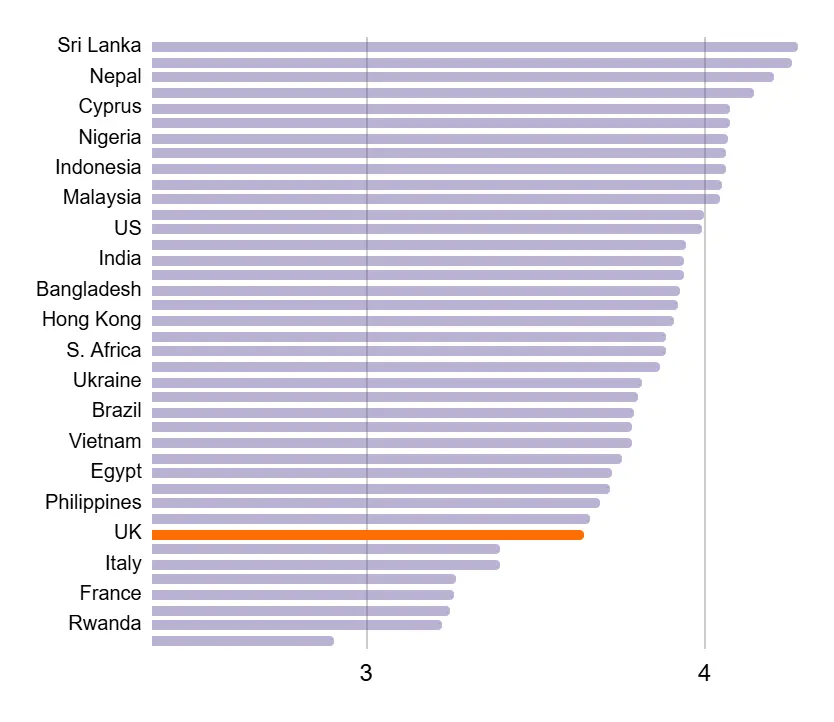
Across all four dimensions, the UK consistently trails behind the global average, ranking in the bottom ten countries for overall optimism.
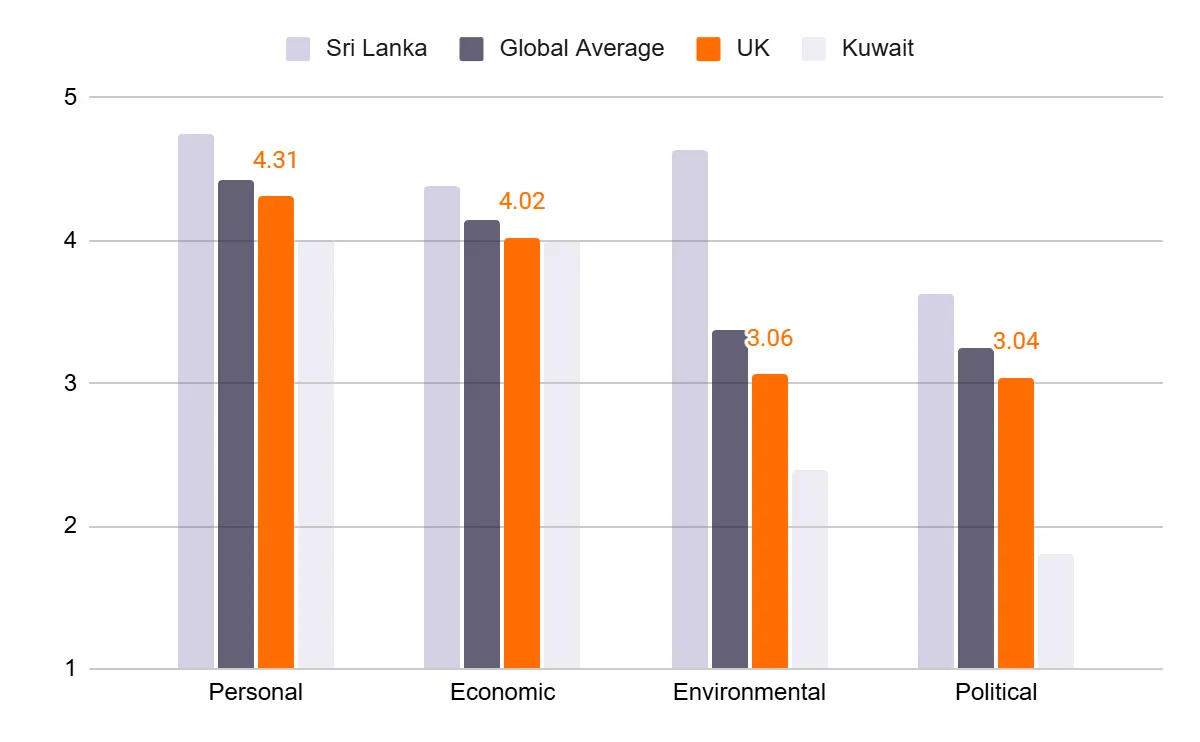
- Highs: Personal (4.31) and economic (4.02) optimism score the highest – aligning with worldwide trends – but remain below the global average.
- Lows: Environmental optimism (3.06) is markedly low, placing the UK in the bottom ten globally. Political optimism (3.04) is also very low, ranking in the bottom eleven countries.
What this tells us: Even in a well-resourced country like the UK, perceptions of political instability and slow progress on climate action significantly dampens overall optimism among students. The UK’s position in the bottom ten is exemplary of a worldwide loss of confidence among young people in the systems beyond their control.
Teenagers’ Top Concerns About the Future
Taken together, the above data shows a strong pattern of individual optimism, alongside a keen awareness of the larger societal challenges. These findings are consistent with the top three concerns cited by students across the globe: climate change, political instability and access to quality education.
| #1 | Climate change |
Rated top 3 by 32 countries and 1st priority by 22 countries |
| #2 | Political instability |
Rated top 3 by 24 countries and 2nd priority by 12 countries |
| #3 | Access to quality education |
Rated top 3 by 20 countries and frequently 2nd/3rd priority |
- Highs: Climate change is by far the biggest concern students have for the future, appearing in the top three for 32 countries. Political instability is also a prominent worry, appearing in the top three for 24 countries.
- Lows: Job automation and affordable housing do not appear as a primary concern for any of the surveyed countries.
- Global trend: Students’ top concerns cluster around environmental risks and political systems. Issues relating to governance, access and long-term societal stability dominate over personal or economic worries.
What this tells us: These findings align with students’ optimism levels across personal, economic, environmental and political dimensions. Primary concerns lie in systemic and structural challenges rather than immediate personal fears.
Help Your Child Think Bigger
Our online internships empower teenagers to actively engage with cutting-edge research and co-author a paper for publication.

What Does This Mean?
Across 40 countries, personal and economic optimism are consistently high – students worldwide believe in their ability to succeed, achieve their goals and take agency over their own lives – yet optimism drops when it comes to environmental and political factors, highlighting widespread concerns about climate change and governance.

This mismatch between high personal and economic optimism and low confidence in environmental and political systems suggests a generation that feels capable individually but uncertain about the world they will inherit. These concerns are apparent worldwide, with the majority of students predominantly worried about the future effects of climate change and political instability.
The next generation is resilient, ambitious and self-assured, but acutely aware of the structural challenges that could shape their future. For educators, policymakers and researchers, these insights highlight specific areas where regional interventions could make a positive impact.
Feel Confident About Your Future
After attending Oxford Scholastica for two weeks in 2025, students reported feeling 25% more optimistic about the future of the world.

Further Reading
For educators:
- How Educators Can Maximise the Impact of Careers Education – Former teacher at one of the UK’s leading skills, Jo Cruse shares her tried-and-tested methods to maximise the impact of careers education in schools.
- How Will AI Affect the World of Work for High Schoolers – Adam Kluge, DPhil candidate at the University of Oxford, explores how educators can best prepare students for an AI-driven workforce across multiple industries.
For parents:
- Purpose Generation: Helping High School Students Choose a Career That Matters – Third generation teacher, Mitch Artman, writes about raising the next generation and how parents can cultivate meaning in their children.
For students:
- How to Develop a Positive Attitude in High School – Insights from Experimental Psychology student, Kylie Li, on developing and maintaining a positive mindset in high school and beyond.
- How to Mitigate Climate Change as a Student – Five actionable ways young people can contribute to mitigating climate change.

By Amy Alsop
Amy Alsop is a Content Editor at the Oxford Scholastica Academy and a postgraduate of the University of Oxford. She brings expertise in academic research, clear communication and data-driven insight, helping students and families understand complex information with confidence.