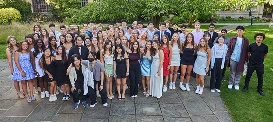
Teenagers today are graduating into a fast-changing, unpredictable world – full of both opportunities and challenges.
At Oxford Scholastica, we recently surveyed over 1,000 students across 40 countries to better understand how teenagers view their future and the world they will inherit. Our findings show that teens feel most optimistic about their own lives – students worldwide believe in their ability to succeed and achieve their personal goals – yet optimism drops when it comes to systems they believe to be outside of their control.
This mismatch suggests a generation that believes in itself yet is unsure how to influence broader global systems. Developing active thinking and high agency can help overcome this barrier.
Key Survey Findings
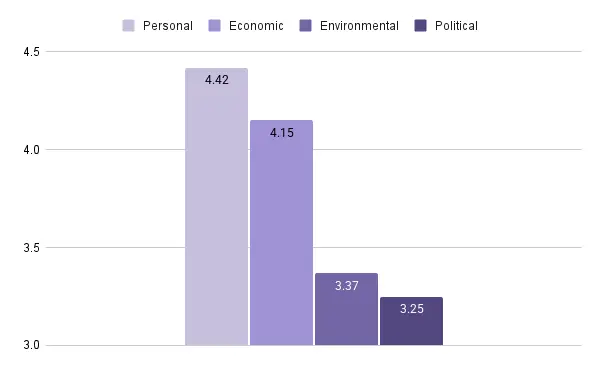
Our survey measured student optimism levels across four areas:
- Personal: personal career, goals and relationships;
- Economic: future job opportunities and financial stability;
- Environmental: climate change and the planet’s natural resources;
- Political: governance, policies and global stability.
Three key findings stood out:
- Teenagers feel most optimistic about their own lives. In 39 out of 40 countries, personal optimism ranked highest (avg. 4.42 out of 5), followed by economic optimism (avg. 4.15), showing strong self-confidence and individual belief.
- Political and environmental optimism are lowest. Scores were significantly lower for political (avg. 3.25) and environmental (avg. 3.37) issues, reflecting widespread distrust in governance and global stability.
- Climate change is the top concern. Across 32 of 40 countries, climate change ranked among teenagers’ top three worries for the future, followed by political instability and access to quality education.
Global Student Optimism Report 2025
Discover what young people from around the world are saying about their future plans and hopes.
What Is High Agency and Active Thinking?
The contrast between strong personal optimism and low confidence in global systems was one of the clearest patterns in the data. This gap highlights a need for more skills that empower teenagers to turn self-confidence into meaningful action.
High Agency
High agency describes a mindset where a person believes they can influence outcomes, take intentional action and proactively shape the world around them. A high-agency teen will take initiative, seek out opportunities and view challenges as chances to engage rather than immoveable obstacles.
For a generation uncertain about political and environmental outcomes, adopting a high-agency mindset moves teenagers from “this problem is too big for me” to “here’s what I can do next”.
Active Thinking
Active thinking complements high agency by encouraging teenagers to approach the world consciously and critically. It involves questioning assumptions, intentionally engaging with information and exploring new perspectives.
This skill is invaluable in navigating misinformation and rapid change. A teenager who engages with active thinking learns to evaluate the credibility of sources, understand complex global issues with nuance and make informed decisions based on their own viewpoints.
Turning Teen Optimism Into Action
The Oxford Scholastica survey shows that teenagers worldwide already have a strong foundation for high agency and active thinking. Globally, personal optimism averages at 4.42 out of 5, reflecting a strong belief among young people in their own abilities and future potential.
This presents an opportunity for the next generation: personal optimism can be channelled into positive action. High agency and active thinking are not innate traits but skills that can be practised and learnt. Developing both can empower teens to approach the future with purpose and confidence.
1. Self-Awareness
A strong starting point for teens is to begin building self-awareness through activities like journalling and goal setting. This includes identifying strengths, passions, motivations, skills and weaknesses by reflecting on questions such as:
- What am I naturally good at?
- Which challenges excite me rather than intimidate me?
- Where do I want to make a difference?
How it builds high agency: Practising self-awareness helps teens to better understand their own abilities and limitations, helping them make intentional and impactful choices rather than waiting for opportunities to arise.
How it builds active thinking: By encouraging self-reflection and critical evaluation, these activities prompt teens to objectively assess situations and plan accordingly.
Ready to Help Your Teen Take the Next Step?
Explore how a summer at Oxford Scholastica can build their confidence and agency.

2. Critical Engagement
After practising self-awareness, teens can start to turn their attention to the world around them by engaging in global issues with a critical mindset. This might involve evaluating sources, questioning assumptions or connecting local issues with global perspectives. Possible activities include:
- Conducting research projects on environmental or political issues
- Participating in group debates
- Hosting simulations of real-world decision making
How it builds high agency: By engaging critically with global issues, students can better understand the causes and interconnections of complex problems, empowering them to identify leverage points where their actions can make a difference.
How it builds active thinking: Practising critical engagement encourages teens to identify bias and connect cause-effect relationships to propose potential solutions. This can shift students from engaging in passive worry to contributing to meaningful change.
3. Experimentation and Evaluation
After some self-reflection and beginning to engage critically with global issues, the next step is to take action in small, manageable ways. This could include:
- Launching micro-projects
- Proposing school or community-based initiatives
- Participating in online internships or collaborative projects
How it builds high agency: Teens gain confidence through experience, translating ideas into action and better understanding the ways in which they can individually affect change. Small successes then reinforce the idea that personal choices can influence larger outcomes.
How it builds active thinking: Iterative problem solving helps teens to build creativity and lateral thinking through evaluating, adjusting and reapplying strategies. This reinforces resilience and repurposes failure as a tool for learning.
Turn Ideas Into Real-World Experience
Our online internships empower teenagers to actively engage with cutting-edge research and co-author a paper for publication.

How Oxford Scholastica Builds Agency and Active Thinking in Teens
At Oxford Scholastica, all of our programmes are designed to build high agency and strengthen active thinking. We teach young people how to think actively, critically and for the long-term. Whether they’re joining us in Oxford for our residential summer school or for one of our online programmes, our students benefit from our unique three-dimensional teaching philosophy:
- Learn: Through engaging classes and Masterclasses, our expert tutors help students build their foundation of knowledge while encouraging critical thinking and intellectual curiosity.
- See: Oxford Scholastica students have the opportunity to meet industry experts and receive practical insights and advice based on their real-world experiences.
- Do: All of our programmes are centred around hands-on activities, problem solving and academic challenges. Teens gain experience and develop essential skills for future success.
The world is uncertain yet young people are capable, optimistic and ready to make a difference. By developing high agency and active thinking, teens can turn their concerns into ideas and their ideas into action.
With the right mindset and the right opportunities, we firmly believe that students can seize the future. Oxford Scholastica offers the environment, community and resources for teens to begin that journey.

By Amy Alsop
Amy Alsop is a Content Editor at the Oxford Scholastica Academy and a postgraduate of the University of Oxford. She brings expertise in academic research, clear communication and data-driven insight, helping students and families understand complex information with confidence.